

The Hybrid Necessity: Why Industrial Generators Are Still Essential in the Era of Solar Power
Outline
7. Conclusion
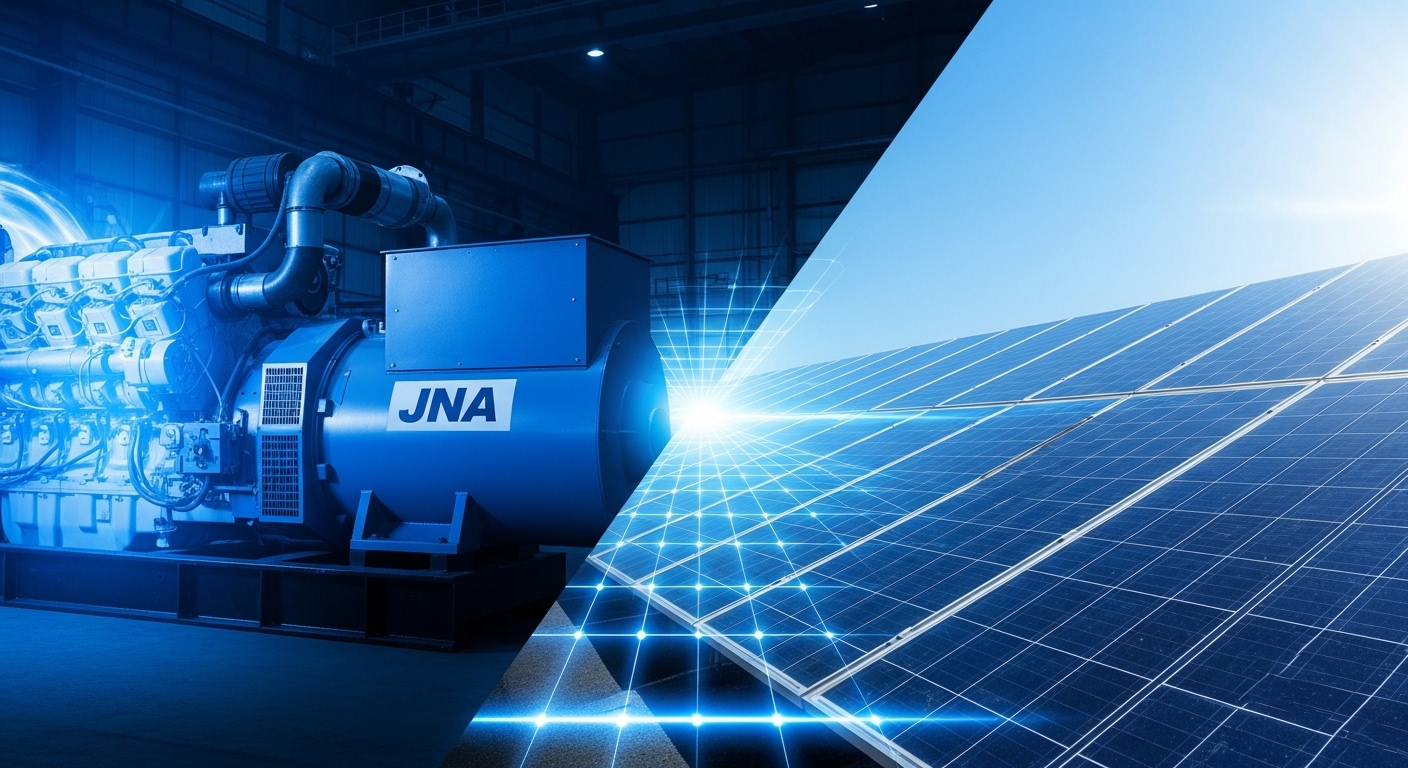
They’re Both There!
Walk through any major industrial zone in Pakistan today and you will notice something interesting. The rooftops are covered in solar panels — and the generator sets are still running.
Pakistan’s solar sector has seen explosive growth. Driven by falling panel costs, crippling electricity tariffs, and a government push for renewables, businesses across the country have made solar a core part of their energy strategy. On the surface, this should be bad news for generator sales. In practice, it is not — and the reason tells you something fundamental about what reliable industrial power actually requires.
Solar is an outstanding solution for cutting energy costs. But cost-cutting and operational continuity are two different problems. The factories, processing plants, and commercial facilities that operate with zero tolerance for downtime have figured this out. They are not choosing between solar and generators. They are using both — in what energy professionals call a Hybrid Power Model — and they are running more reliably than ever before.
Here is exactly why Industrial Generators are not just surviving the solar era — they are becoming more indispensable within it.
1. Solar Is Intermittent. Industrial Demand Is Not.
The single most important fact about solar power is also the one most often glossed over in commercial pitches: solar panels only generate electricity when the sun is shining.
In Pakistan, that sounds straightforward — we get plenty of sunlight. But production floors operate three shifts. Monsoon clouds roll in for weeks at a time. Dust storms cut solar output by 30 to 60 percent with no warning. And at 6:00 PM, when the evening shift is running at full capacity, the panels go dark entirely.
This is what engineers call the intermittency problem. Solar generates power on nature’s schedule, not yours. Industrial operations demand what is known as a consistent baseload — a floor of reliable power that is available on command, 24 hours a day, seven days a week.
How Generators Help?
A properly sized generator solves this completely. The moment solar output dips below operational requirements — whether due to cloud cover, nightfall, or a sudden production spike — the generator steps in seamlessly, maintaining 100% uptime without any intervention. No production pause. No process restart. No lost hours.
The theoretical fix for solar intermittency is battery storage. But large-scale Battery Energy Storage Systems (BESS) capable of sustaining industrial operations through an 8 to 12 hour overnight period carry a capital cost that remains prohibitive for the vast majority of Pakistani manufacturers. Until battery economics shift dramatically, the generator is not a backup — it is the backbone.
2. Heavy Machines Need a Power Source That Can Handle the Surge
Here is a technical reality that every factory manager who has tried to run heavy equipment off a solar-only system has encountered firsthand:
Large inductive motors — compressors, lathes, crushers, pumps, conveyor systems — do not draw a steady amount of power. When they start up, they demand a sudden, massive spike of current known as inrush current, which can be five to seven times the motor’s normal running load. This startup surge lasts only a few seconds, but it is violent enough to trip inverters and cause voltage collapse across the entire system.
Solar Has Limits
Solar inverters — even high-quality, industrial-grade ones — have strict limitations when it comes to handling these high-inertia loads. Most are designed to operate within tight voltage and current tolerances. A sudden 600% surge from a motor startup is precisely the kind of event that pushes a solar inverter past its limits, causing a fault trip that takes down the entire solar array.
A diesel or gas generator has no such constraint. Its rotating mass — the engine and alternator working together — provides what engineers call mechanical inertia. This inertia absorbs sudden load changes gracefully, allowing the generator to supply whatever surge of current is needed at startup without any system instability. For operations running CNC machines, large HVAC compressors, or heavy fabrication equipment, this capability is not optional — it is a core operational requirement.
3. The National Grid Is Not a Safety Net — Your Generator Is
Pakistan’s national grid infrastructure is undergoing long-term improvement, but the operational reality for most industrial consumers remains challenging. Voltage fluctuations, unannounced load shedding, frequency deviations, and sudden feeder trips are a routine part of the energy landscape in most industrial estates.
For sensitive industrial processes — pharmaceutical production, food processing, electronics assembly, precision machining — a grid instability event is not merely an inconvenience. It can mean spoiled batch production, calibration loss on precision equipment, damaged PLCs and control systems, or safety risks on the production floor. The cost of a single unplanned shutdown can easily run into hundreds of thousands of rupees.
Solar panels connected to the grid offer no protection against this. In fact, grid-tied solar systems are designed to shut down automatically when the grid fails — a safety protocol called anti-islanding. When the grid goes down, your solar goes down with it.
For FULL Independence, Come to Generators
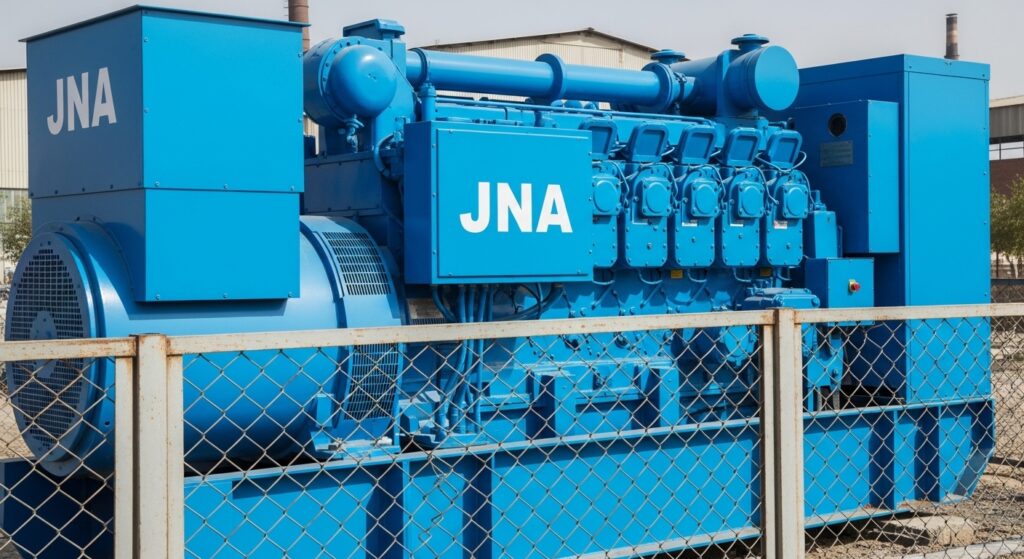
A generator operates with full independence from the grid. It is your facility’s private power utility. Whether it is a city-wide outage, a feeder fault specific to your industrial estate, or a frequency deviation that trips your sensitive equipment — the generator keeps your operation running, fully isolated from whatever is happening on the national network.
Think of a generator not as a cost center but as energy insurance. The premium you pay is the fuel and maintenance cost. The claim you avoid is the catastrophic loss of a shutdown at the worst possible moment.
4. Space Constraints and Storage Economics Still Favour Generators
There is a scale argument for solar that works very well — on paper. Cover enough roof or ground area with panels, add enough battery storage, and you can theoretically run an industrial facility entirely on solar. The problem is that both of those requirements become increasingly impractical at industrial scale.
A 500 kW solar installation requires approximately 3,000 to 3,500 square metres of unshaded, structurally sound panel area. Most urban and semi-urban industrial facilities in Pakistan — operating out of constructed sheds, multi-storey factories, or leased commercial units — simply do not have that footprint available. Even where rooftop space exists, structural load ratings, orientation constraints, and shading from adjacent buildings frequently limit what can be practically installed.
Financial Decisions Involved
The storage equation is equally unforgiving. To provide 8 hours of overnight backup for a 500 kW facility using lithium-ion BESS, you are looking at a battery bank investment in the range of PKR 80 to 120 million at current market prices — before installation, civil works, and the associated solar capacity required to charge it. For most businesses, that capital expenditure timeline simply does not make financial sense.
A 500 kVA generator, by contrast, occupies roughly 10 to 15 square metres of floor space, can be operational within days of purchase, and delivers its full rated power on demand from the first day of installation. On a cost-per-reliable-kilowatt basis, for backup and surge capacity specifically, generators remain unmatched.
The Bottom Line: Solar and Generators Are Partners, Not Rivals
The most resilient industrial operations in Pakistan are not the ones that have committed entirely to solar, nor the ones that have resisted it. They are the ones that have been smart enough to use both technologies for what each does best.
Solar panels are exceptional at reducing your daytime grid dependency and cutting your per-unit electricity cost over a 25-year lifespan. Industrial Generators are exceptional at delivering unconditional, on-demand power for surge loads, overnight operations, and grid failure scenarios. Together, they create a Hybrid Power infrastructure that is simultaneously more cost-efficient and more operationally secure than either solution alone.
Integeration is the Key!
The businesses that understand this are not asking whether to install solar instead of a generator. They are asking how to size and integrate the two correctly — so they get the cost savings of solar without sacrificing the operational certainty that only a generator can provide.
If you are at that stage — planning a solar installation and need to determine the right generator capacity to complement it, or upgrading your existing backup power to match a growing facility — JNA Private Limited can help.
With decades of experience supplying and commissioning Industrial Generators across Pakistan, our team can assess your load profile, identify your critical power gaps, and recommend a Hybrid Power solution built specifically for your operational requirements.
Contact JNA Private Limited today and let’s build a power strategy your business can rely on — regardless of the weather, the grid, or the time of day.
Conclusion
In conclusion, when purchasing residential diesel generators, homeowners should consider key factors such as power output, size, portability, and noise level. With the guidance of trusted providers like JNA Pvt Ltd, homeowners can find the perfect generator to meet their needs and enhance their emergency preparedness.
Unique FAQs
1. What appliances can be powered by a residential diesel generator?
Residential diesel generators can power essential appliances such as refrigerators, lights, heating systems, and communication devices during outages.
2. How long can a residential diesel generator run on a full tank of fuel?
The runtime of a residential diesel generator depends on factors such as the generator’s fuel efficiency and the load being powered. It’s advisable to consult with experts to determine the appropriate fuel capacity for your needs.
3. Are residential diesel generators easy to maintain?
With proper maintenance and servicing, residential diesel generators can provide reliable performance for years. Regular checks of fuel levels, oil changes, and occasional servicing by qualified technicians are recommended.
4. Can residential diesel generators be used indoors?
It’s not recommended to operate diesel generators indoors due to the risk of carbon monoxide poisoning. Generators should be placed in well-ventilated outdoor areas to ensure safe operation.
5. How can homeowners ensure their residential diesel generator is ready for use during an outage?
Regular testing and maintenance of the generator, along with keeping adequate fuel supplies on hand, ensure that residential diesel generators are ready to provide backup power when needed.